_edited.png)

CASE STUDY
FIRESTOP SOLUTIONS OF IOWA – BUILDING THE TEAM AND RELATIONSHIPS FOR THE NEXT MARKET
For Firestop Solutions of Iowa, entering new markets required more than finding the next project. The company needed people, contractor relationships, and an operating approach that could accommodate travel and local costs. GTI worked with Robert Cronquist on the connections among recruiting, business development, and expansion.
The management challenge
A specialty contractor can have promising opportunities while still facing uncertainty about staffing and location costs. Dependence on a concentrated project segment adds another reason to develop broader relationships. GTI’s role was to help make expansion more concrete: define roles, decide who would handle recruiting, and consider a lower-commitment way to test a market before taking on a long-term facility obligation.

How GTI’s support was divided

From discussion to practical follow-through

Defining the role before starting the search
In May, GTI helped finalize an estimator posting and a compensation structure that considered experience, mileage, and company performance. Sam committed to posting the role and providing application access. The team worked through what the role required and how the search would be managed before treating recruitment as a job posting alone.
Clarifying recruiting responsibilities
By August, the discussions distinguished routine entry-level hiring through Indeed from more involved searches using ZipRecruiter and Sam’s participation. That made the handoff more explicit. An owner should be able to tell which hiring activity the business is handling directly and where the consulting partner is expected to take a more active role. The records support that division of responsibility.
Connecting outreach with the operating plan
Sam proposed a targeted introduction campaign to approximately 30 contractors around Des Moines, combining branded material, personal notes, and follow-up calls. Supplier and subcontractor relationships were also discussed as routes to introductions. Alongside outreach, the team considered a temporary location for testing a market. The prospect count described a plan, not 30 completed contacts or awarded projects.
Why the work belonged together
GTI acted as a hiring and business-development partner who could also ask how growth would be staffed and financed. The value was in connecting those decisions, so the owner did not have to treat recruiting, sales materials, and expansion as unrelated projects.
What needs to be ready before the next market becomes a commitment?
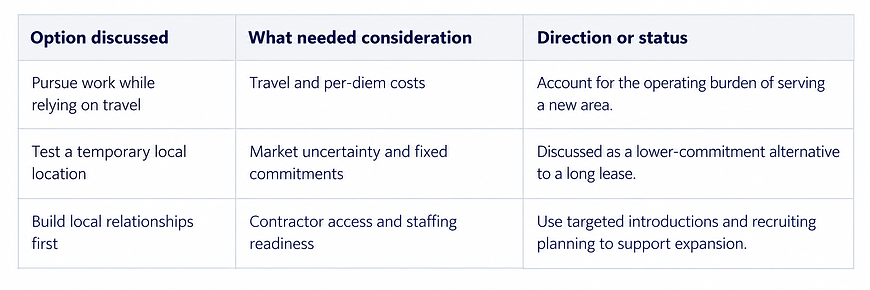
The following comparison summarizes the options and trade-offs raised in the engagement, including the considerations behind each choice and its status at the time of review.
How GTI helped evaluate the choice
These options could be sequenced rather than treated as an immediate all-or-nothing expansion. A temporary location was a way to explore operating requirements. Relationship development could improve access to opportunities, while recruiting determined whether the company could staff them. GTI helped keep those questions connected instead of allowing a sales opportunity to dictate the entire growth plan.
The operating detail behind the decision
A recruiting plan becomes more useful when it is connected to the work the company intends to pursue. Contractor introductions could uncover opportunities, but those opportunities would carry staffing and delivery requirements. The discussion of a temporary location addressed another part of the same decision: how to learn about a market without immediately accepting a long-term facility commitment. The plan therefore combined commercial ambition with operating questions.
What the owner could use from the discussion
The discussion put estimator capacity, installer recruitment, contractor relationships, and market-entry costs into a single decision. That gave the owner a way to examine which constraint required attention first, what information was still missing, and whether the next commitment fit the business’s ability to carry it out.
What the engagement demonstrates

Results and completed work
The record supports an estimator role and compensation-planning process, clearer recruiting ownership, and a more specific outreach agenda. By September, the brochure and prospect list were nearing completion. Completed hires attributable to GTI, new-market awards, and revenue from proposed new channels were not established.
The owner-support dimension
Robert worked with GTI across recruiting details, introductions, and market-entry choices. The support was practical: a broad growth ambition became a discussion of specific responsibilities, materials, contacts, and cost exposure. GTI helped organize the next steps while the company continued testing its growth plans.
Where the work continued
The work created a more deliberate expansion agenda, with staffing, travel, facilities, and relationships visible together. The next stage was execution and learning from those activities. Firestop’s case demonstrates hiring and business-development support grounded in the realities of operating the work
Case basis: selected client meetings and supporting engagement records through September 2026. Owner-reported activity and planning options are identified in the text. The case describes the work and decisions recorded during this period.