_edited.png)

CASE STUDY
METAL SUPERMARKETS | CEDAR RAPIDS – PROTECTING CASH AND EXECUTION DURING A STRONG SALES MONTH
At Metal Supermarkets Cedar Rapids, a strong sales period brought attention to the controls needed to support a busier operation. GTI worked with Rick Heller on deposits, customer credit, collections, forecasting, and order execution. The conversation connected commercial activity with the practical work of turning it into usable cash.
The management challenge
Sales and cash are related but arrive on different schedules. Customers may have payment arrangements, orders may require material commitments, and documentation or operating interruptions can delay completion. GTI helped the owner look at those decisions together. The focus was on practical controls and the information needed to make the next decision.

How GTI’s support was divided
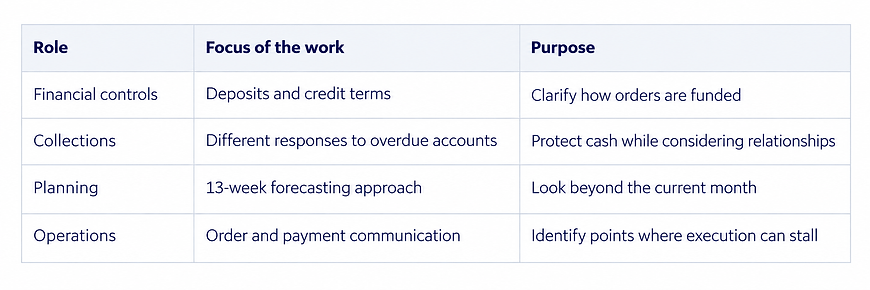
From discussion to practical follow-through

Distinguishing different collection situations
GTI and Rick considered the difference between customers responding within an agreed arrangement and overdue accounts that were not responding. That distinction made the discussion more useful than applying the same escalation to every account. The work connected collection discipline with the relationship history and the information available, while keeping individual customer details private.
Reviewing deposits and credit expectations
The meeting covered net-30 terms, deposits commonly near 30%, and using credit reviews to inform account limits. The team also considered whether a lower order threshold should trigger a deposit. These were decisions about how much customer activity the business should finance and when it should ask for payment, rather than simply whether it could win another order.
Building the basis for deeper financial review
Sam demonstrated a 13-week forecasting approach and identified transaction-level sales data as useful for examining customers, products, and margins. Rick forwarded corporate reporting and a material breakdown. Those records created a basis for further work; they did not establish that a complete forecast or a detailed customer-profitability analysis had already been implemented.
Why the work belonged together
The case shows how an advisory partner can remain useful after demand improves. GTI helped Rick focus on the decisions that determine whether sales turn into cash and whether the business can serve customers consistently as activity increases.
How do strong sales become dependable cash and consistent service?
The following comparison summarizes the options and trade-offs raised in the engagement, including the considerations behind each choice and its status at the time of review.

How GTI helped evaluate the choice
These choices show the balance involved in financial control. A responsive customer and an unresponsive account create different management problems. Deposit requirements change the timing of cash before an order is complete. GTI’s role was to help Rick consider those differences and connect the policy conversation with order execution and a forward view of cash requirements.
The operating detail behind the decision
The forecasting demonstration provided a way to extend the discussion beyond the month just completed. Transaction detail would be needed to examine which products and customers contributed to performance. Collection policy addressed a different question: when the proceeds of that activity would be available. By bringing those topics together, GTI helped Rick examine the quality and timing of the commercial result.
What the owner could use from the discussion
The discussion put deposit expectations, customer credit, order execution, and forward cash planning into a single decision. That gave the owner a way to examine which constraint required attention first, what information was still missing, and whether the next commitment fit the business’s ability to carry it out.
What the engagement demonstrates

Results and completed work
The reviewed record establishes a defined management agenda covering account escalation, deposits, credit limits, forecasting, and further analysis. Reports were supplied and the forecasting approach was demonstrated. It does not establish a measured reduction in overdue balances or a completed forecast implementation.
The owner-support dimension
Rick supplied follow-up information and engaged in discussion of both results and operating problems. The recurring advisory setting gave him a place to move from a strong sales report to the next collection decision or documentation issue. That breadth is the support story: GTI could participate in the practical questions that followed the good news, rather than ending the engagement at the sales number.
Where the work continued
The value of the next stage would depend on policy follow-through and more detailed operating information. This case shows GTI connecting sales success with cash discipline and service delivery, while keeping unverified financial improvements out of the results claim.
Case basis: selected client meetings and supporting engagement records through September 2026. Owner-reported activity and planning options are identified in the text. The case describes the work and decisions recorded during this period.